


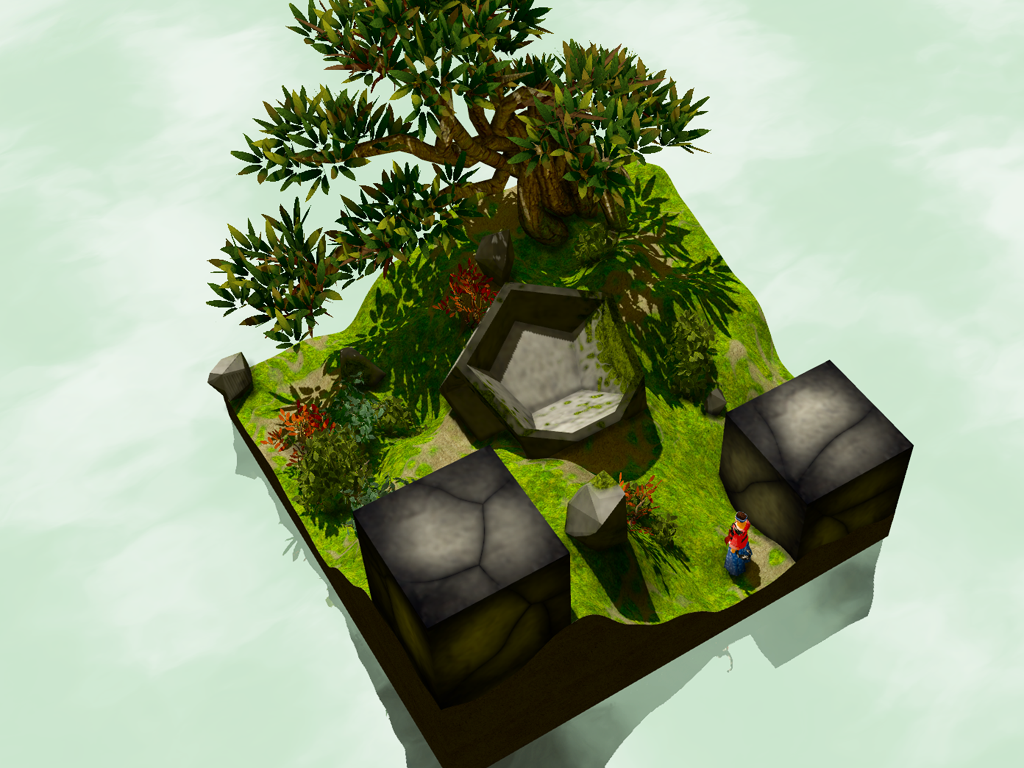

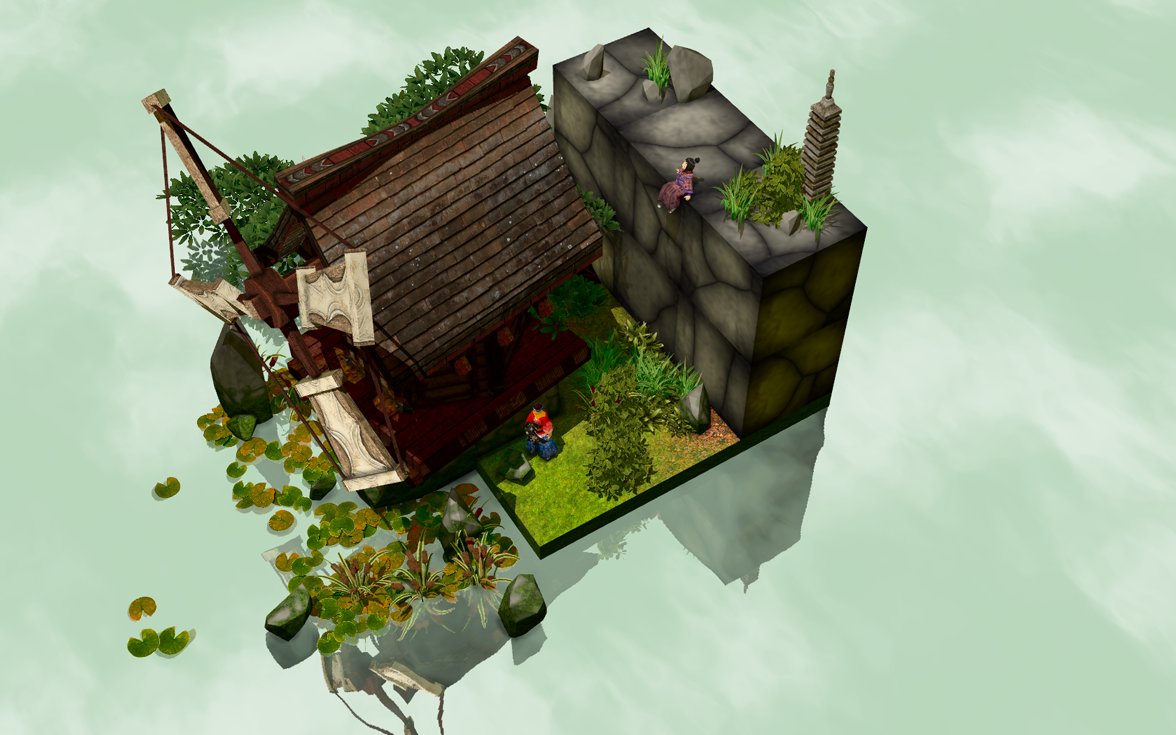
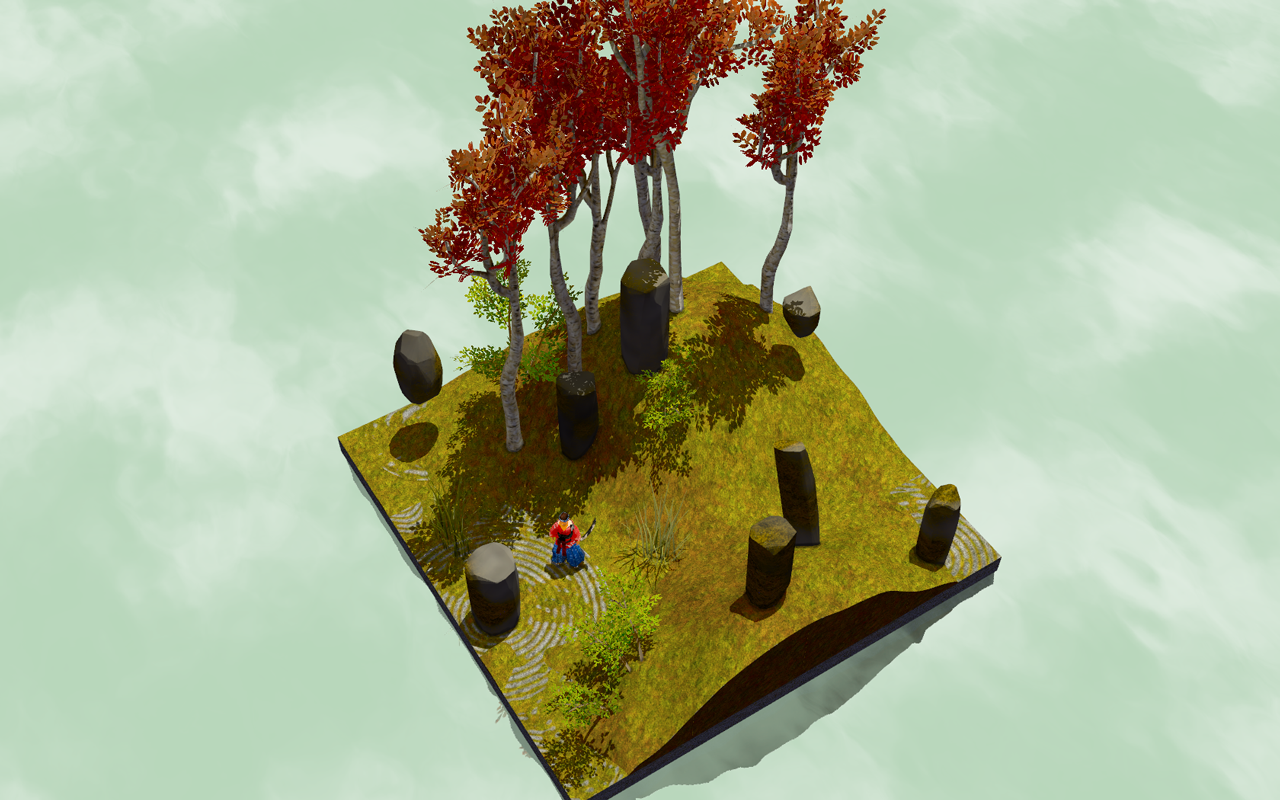
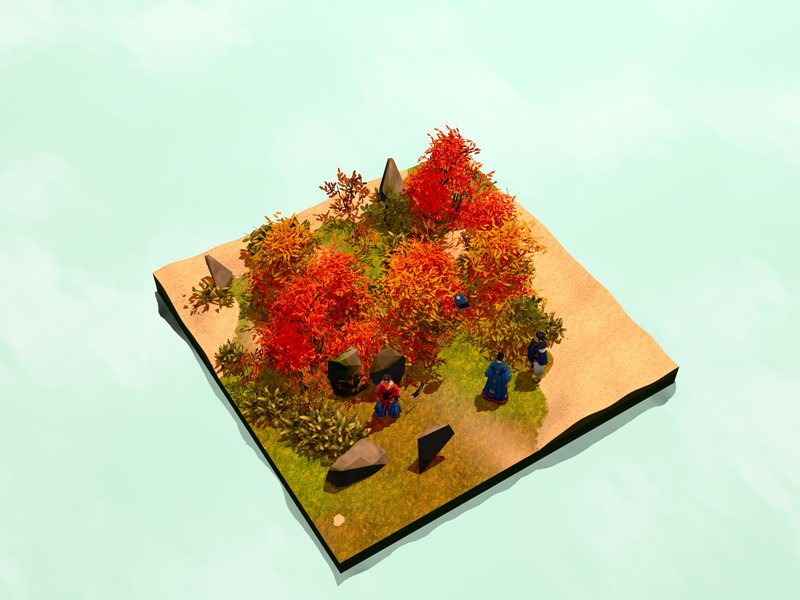


Miegakure [Hide and Reveal] is the first game that lets you explore and interact with a 4D world. In this game, the fourth dimension is not time! It is an actual fourth dimension of space, that works just like the first three dimensions we are familiar with. If you count time, this game is 5D.
"[I messed] about with this strange toy until I quickly understood most of the problems that I faced."
Jim Rossignol, Rock Paper Shotgun
"When I did finally get it, I realized how fantastic Miegakure could be."
Tyler Wilde, PC Gamer
"It's amazing how fluid the transitions between dimensions are, and how much sense it makes once you play."
Chloi Rad, IGN
"Faced with a level in which I had to appear atop a floating box on another cross-section of the hyperworld—on the other side of the screen—I found that I knew where to stand in 4-D space to pull it off."
Chris Suellentrop, Wired Magazine
"I find it easy to think of Miegakure as one of the great puzzle games of all time."
Jonathan Blow, Braid, The Witness
How to walk through walls using the 4th Dimension [And an explanation of how Miegakure works]
A look at the Technology behind the 4D Game Miegakure
 For a while games used to be 2D, taking place solely along two directions. For example, a game character could only move forwards and backwards, or jump up and down. Then came computers powerful enough to render 3D graphics, which allowed for full 3D movement: up / down, backwards / forwards and left / right. (Of course, the graphics we see, while they are computed in 3D, are displayed on a 2D screen. They are projected down from 3D to 2D, in a way that mimics how our eyes perceive the third dimension.)
But it doesn’t stop there. If in a 2D game every object’s position is represented in the computer using two numbers, and if in a 3D game every object’s position is represented using three numbers, what if each position was represented using four numbers? In other words, what if there was another direction you could move along in addition to the first three? Trying to answer this question is what that led us to develop this game.
As far as we know, our universe has exactly three spatial dimensions — so it’s difficult for us to picture what a four-dimensional world would look like. But a computer, on the other hand, does not care; it’s just working with numbers as usual (it’s just slightly more numbers in this case!). So we had to come up with a way to display this 4D world so that our three-dimensional brains could comprehend it.

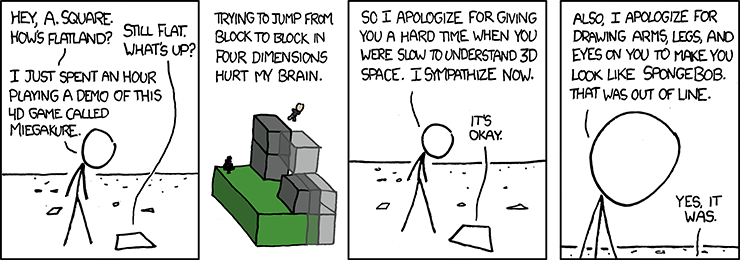
 The way we chose is a method that has been popularized in the novella Flatland. This novella talks about a 2D square that can only see a 2D cross section of a 3D world. For the square, the third dimension is invisible and mysterious; the square has no concept of it because it is stuck seeing a 2D world. If a 3D object visits the 2D plane it appears to be deforming, in a way that looks like an M.R.I. scan. In an M.R.I. what we see appears to be deforming, but we know that we are just taking a different cross-section of the same 3D object.
In Miegakure [Hide and Reveal] a similar thing happens, but in one higher dimension: instead of taking a 2D slice of a 3D object, we are taking a 3D slice of 4D objects. It’s hard to imagine, but luckily we don’t have to — computers can display it for us! If you take a look at the trailer above you can see examples of what these “deformations” look like as we move and turn the 3D slice around within the 4D world.
 The gameplay focuses on exploring a 4D world and the consequences of being able to move in 4D. For example, for a 2D being, houses only need four walls. If the doors are locked, there is no way to enter the house. But us 3D beings can see inside the house by just looking at it from the third dimension, and we can reach in and grab whatever is inside and move it outside the house, without opening any doors, to the bemusement of the poor 2D beings!
Similarly, a 4D being can perform miraculous feats such as remove objects from a locked safe without opening it, bind together two rings without breaking them, or spy on 3D beings without them knowing. We have carefully designed each level in Miegakure to be about performing one of these feats, letting players become a sort of superhero from the actual fourth dimension.
F.A.Q.
When is the game coming out?
As soon as possible, we are very far along but haven't announced a release date yet.
Will you do an early-access / public alpha / beta?
Early-access and Public alphas/betas don't really make sense for single-player puzzle games with a story.
Is there a demo?
No.
What platforms is the game coming out on?
The goal at this time to release on as many things as possible but initially focus on Steam for Windows.
Why does the game slice the 4th dimension instead of projecting it? Wouldn't it make more sense to project since our eyes see using projections?
- I wanted the 4D world to feel like an extension of the 3D world we live in.
- Our eyes project from 3D to 2D, which is one dimension down. 4D to 2D is two dimensions down: a lot of objects are going to overlap on the screen, which makes things hard to understand.
- We do have projections of some sort, stay tuned for details.
Why make the main mechanic about rotating the slice, since translating the slice seems simpler?
When you translate the slice you cannot see where you are going, so you can hit walls you can't see, which is confusing. Translating the slice is unlocked later in the game.
Will you be able to rotate the 3D slice however you want?
Yes, but not initially in order to teach players in a more gradual way, and because many puzzles are more fun with this limitation.
Is the 2D/3D version of the game part of the game?
Yes! It is used throughout the game to help players understand the 4th dimension.
Does the 4D exist in real-life?
As far as we know our universe is 3D, but there are physics theories (such as string theory) that say that it may have more dimensions.
Will you release the source code?
Not at first. However the game is scriptable, therefore easy to mod.
If we can't comprehend the 4th dimension how was this program even made?
Writing 4D math is often not much more complicated than writing 3D math, so one can write it and just see what the computer displays. Many programs are already about things we can't fully predict, such as fluid dynamics.
Selected Press
Miegakure preview — playing a four-dimensional puzzle game [PC Gamer]
Videogame architecture allows us to visualize the impossible [Kill Screen]
This Man Is Using Math To Create An Impossible 4D Video Game [The Creators Project]
Hands On: Miegakure [Rock Paper Shotgun]
Mind Game [Wired (Dec. 2014 issue)]
Interview with Miegakure’s Marc ten Bosch [N4G]
The Man Who Will Bring Us To The Fourth Dimension [Kotaku]


To The Inhabitants of SPACE IN GENERAL
And H. C. IN PARTICULAR
This Work is Dedicated
By a Humble Native of Flatland
In the Hope that
Even as he was Initiated into the Mysteries
Of THREE Dimensions
Having been previously conversant
With ONLY TWO
So the Citizens of that Celestial Region
May aspire yet higher and higher
To the Secrets of FOUR FIVE OR EVEN SIX Dimensions
Thereby contributing
To the Enlargement of THE IMAGINATION
And the possible Development
Of that most rare and excellent Gift of MODESTY
Among the Superior Races
Of SOLID HUMANITY
- Edwin A. Abbott, Flatland: A Romance of Many Dimensions